
Two systems, two bodies, two logics
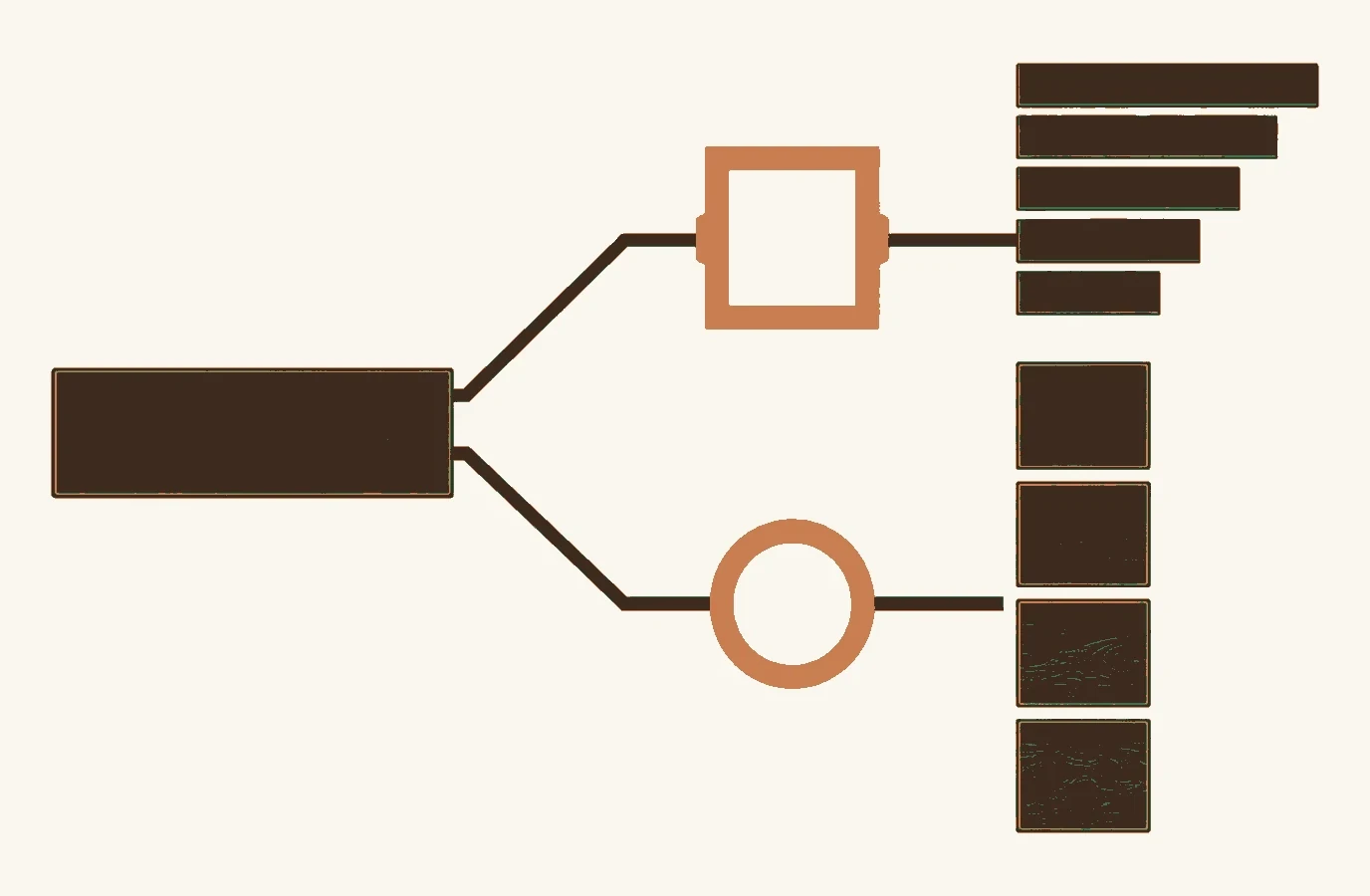
There are two grading systems in the life of a hardwood floor and they measure different things. They are published by different organisations, in separate documents, and the flooring standard does not cross-reference the lumber rules at all.
The National Hardwood Lumber Association grades lumber. It describes itself as the official governing body responsible for developing, maintaining and interpreting the hardwood lumber grading rules in North America, and has done so for more than 125 years. An NHLA grade answers one question: how much clear, usable material will this board yield when it is cut up.
The National Wood Flooring Association, through the NOFMA standard, grades finished flooring. Its logic is the opposite, and the standard says so in a single sentence that should be printed on every showroom wall: appearance alone determines the grades of hardwood flooring since all grades are equally strong and serviceable in any application.
So a lumber grade is a statement about yield, and a flooring grade is a statement about looks. Neither is a statement about strength. A No. 2 Common floor is not a weak floor; it is a floor with more character marks, and the NWFA describes it as most desirable where numerous notable character marks and prominent colour contrast are wanted.
NHLA: a grade is a yield of clear cuttings
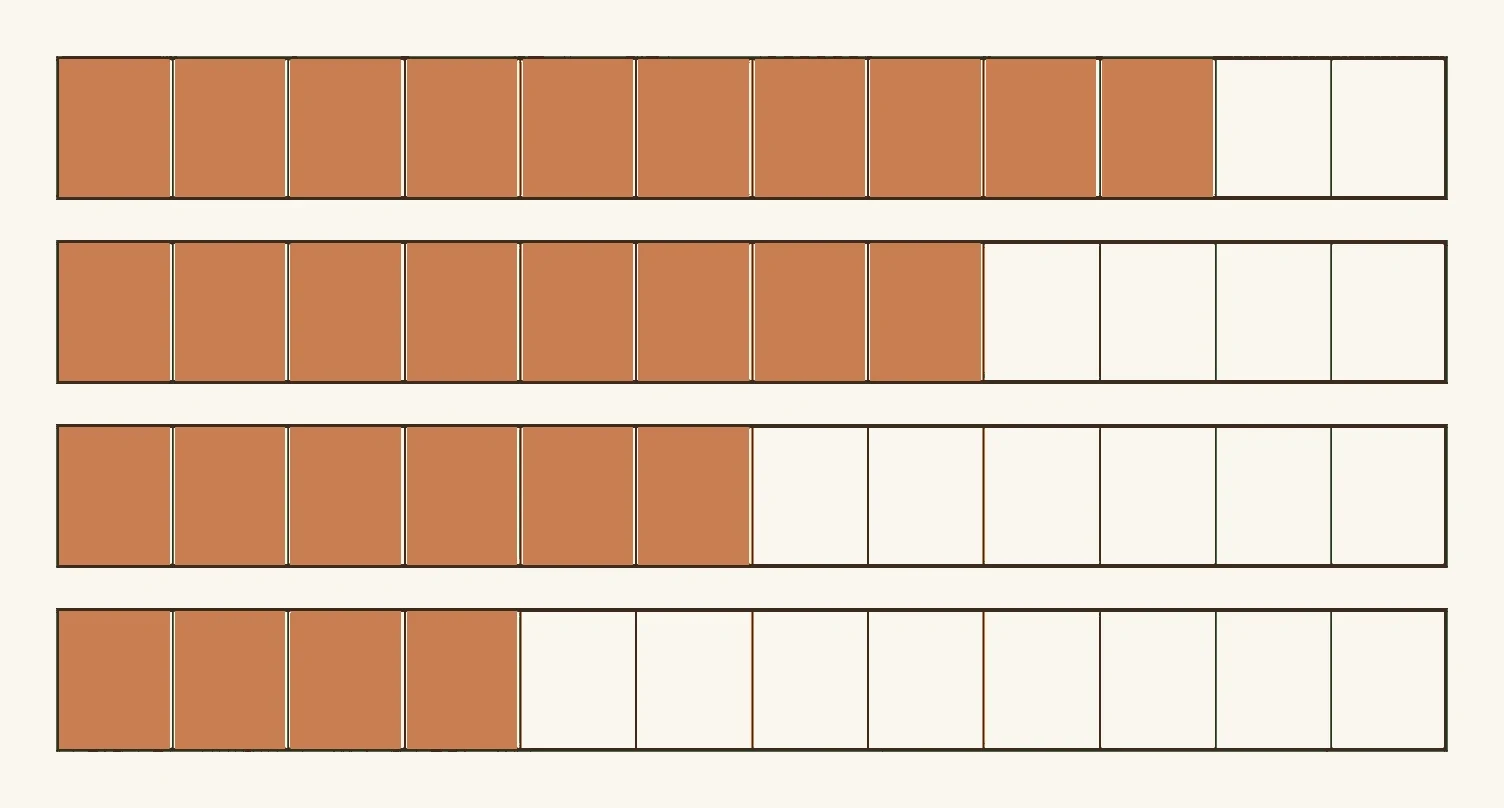
The NHLA rulebook effective 1 January 2023 sets each grade as a combination of minimum board size, minimum cutting size, and a required clear-face yield expressed in twelfths.
FAS — the top grade, from the historical "Firsts and Seconds" — requires boards 6 inches and wider, 8 to 16 feet long, a minimum cutting of 4 inches by 5 feet or 3 inches by 7 feet, and a clear-face yield of 83-1/3%, written as 10/12. FAS One Face grades not below FAS on the better face with the reverse not below No. 1 Common. Selects drop the width to 4 inches and wider at 6 to 16 feet.
Below that the yield steps down in clear increments: No. 1 Common at 66-2/3% or 8/12, from boards 3 inches and wider admitting 5% of 3-inch widths; No. 2A Common at 50%, or 6/12, on a minimum cutting of 3 inches by 2 feet; No. 3A Common at 33-1/3%, or 4/12.
The important structural fact is that this grade is fixed at the sawmill and never improves. A No. 1 Common board is not upgraded by a good finish; it is a board with a known clear yield, and everything a flooring mill does downstream works within that.
| Grade | Board minimum | Minimum cutting | Clear-face yield |
|---|---|---|---|
| FAS | 6" and wider, 8–16 ft | 4"×5 ft or 3"×7 ft | 83-1/3% (10/12) |
| FAS One Face | 6" and wider, 8–16 ft | 4"×2 ft or 3"×3 ft | FAS on better face |
| Selects | 4" and wider, 6–16 ft | 4"×3 ft or 3"×6 ft | FAS on better face |
| No. 1 Common | 3" and wider, 4–16 ft | 4"×2 ft or 3"×3 ft | 66-2/3% (8/12) |
| No. 2A Common | 3" and wider, 4–16 ft | 3"×2 ft | 50% (6/12) |
| No. 3A Common | 3" and wider, 4–16 ft | 3"×2 ft | 33-1/3% (4/12) |
NWFA/NOFMA: a grade is an appearance
The NWFA/NOFMA International Standards for Unfinished Solid Wood Flooring, revised April 2018, replaced all editions of the Official Flooring Grading Rules previously published by the Wood Flooring Manufacturers Association. It grades by species group, because the same character mark means different things in oak and in maple.
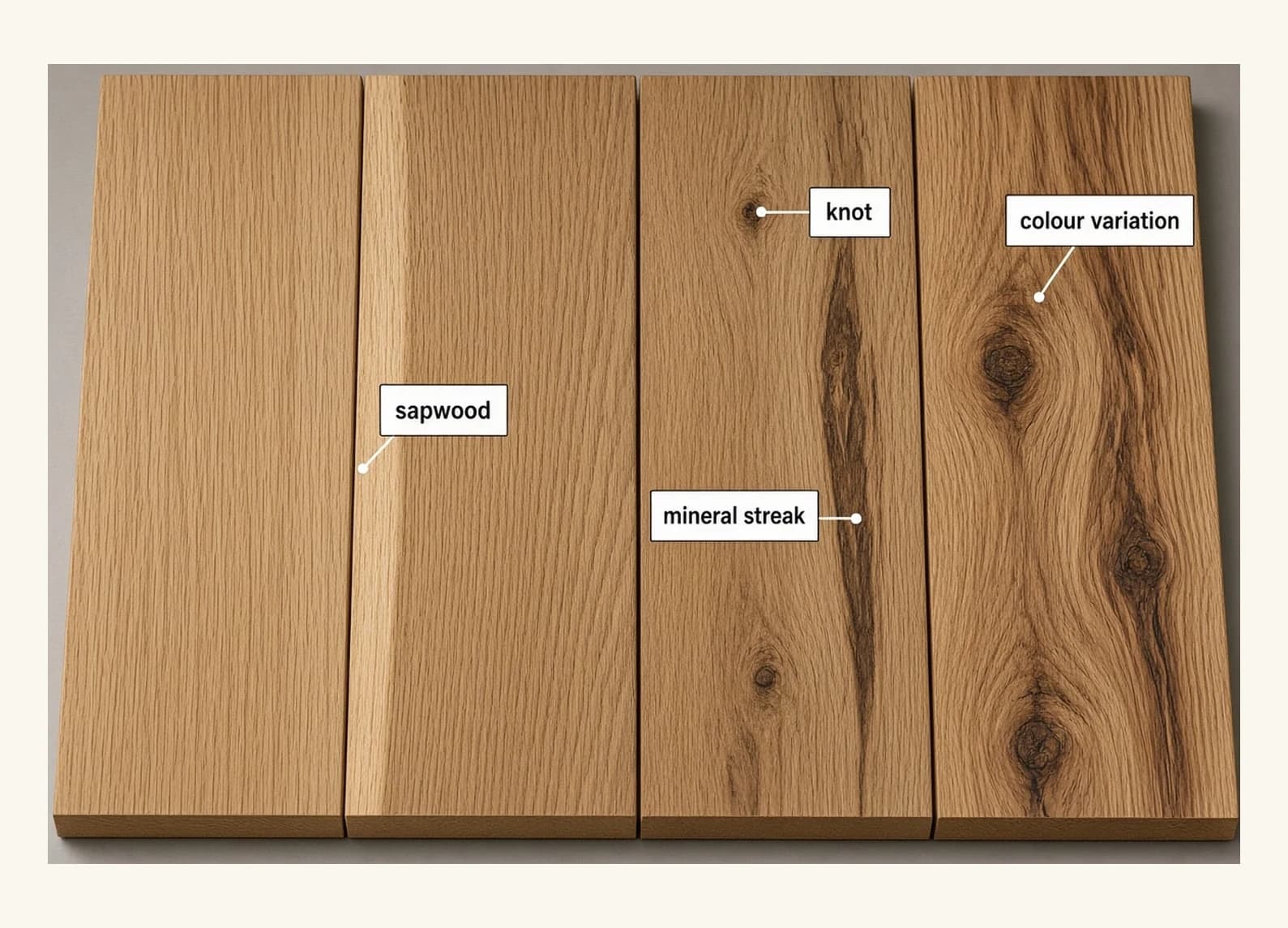
For oak the ladder runs Clear, Select, No. 1 Common, No. 2 Common. Clear is a heartwood-dominant product allowing minimal character marks — it still permits up to 3/8 inch of bright sapwood along the full length, small burls, fine pin worm holes, tight checks and occasional thin brown streaks. Select permits unlimited sound sapwood, one small tight knot per 3 feet, slightly open checks and intermittent machine burns not exceeding a quarter inch.
No. 1 Common admits open characters such as checks and knot holes, provided they are sound and fillable, and excludes broken knots over half an inch and splits through the piece. No. 2 Common accepts sound natural forest variations and manufacturing imperfections while prohibiting shattered or rotten ends, large broken knots, shake and advanced rot.
For hard maple, beech and birch the top grade is Select & Better: a nearly defect-free face with natural colour variation permitted, allowing occasional pin knots to 1/8 inch, dark green or black spots to a quarter inch by 3 inches, bird’s eyes and small burls. The equivalent ladder continues through No. 1 Common and No. 2 Common, the latter defined as flooring that must provide serviceable flooring with firm wood.
| Grade | What it permits |
|---|---|
| Clear | Heartwood-dominant, minimal character. Up to 3/8" bright sapwood full length, small burls, fine pin worm holes, tight checks, occasional thin brown streaks. |
| Select | Unlimited sound sapwood, one small tight knot per 3 ft, pin worm holes, burls, slightly open checks, two flag worm holes per 8 ft, machine burns to 1/4" wide. |
| No. 1 Common | Open characters — checks and knot holes — that are sound and fillable. Excludes broken knots over 1/2" and splits through the piece. Sticker stain permitted. |
| No. 2 Common | Sound natural forest variations and manufacturing imperfections. Prohibits shattered ends, large broken knots, shake and advanced rot. |
Moisture content, fixed at the mill
The same standard sets the moisture content flooring is manufactured at: 6% to 9%, with a 5% allowance for pieces outside that range up to 12%.
That is a manufacturing specification, not a site condition, and the gap between the two is where most Toronto floor failures live. The NWFA installation guidance puts the interior operating environment at 30 to 50 percent relative humidity and 60 to 80 degrees Fahrenheit, and sets the permitted difference between properly acclimated flooring and subfloor at no more than 4 percentage points for strip under 3 inches, and no more than 2 for wide-width flooring 3 inches or wider. It also asks for a minimum of 20 moisture readings per 1,000 square feet, averaged.
We attribute those last three figures carefully. They come from copies of the NWFA installation guidelines hosted by third parties and dated 2007 to 2008; the current guidelines are members-only. The 6% to 9% manufactured range, by contrast, is from an NWFA-hosted document revised April 2018.
Thickness, strip, plank, wide plank
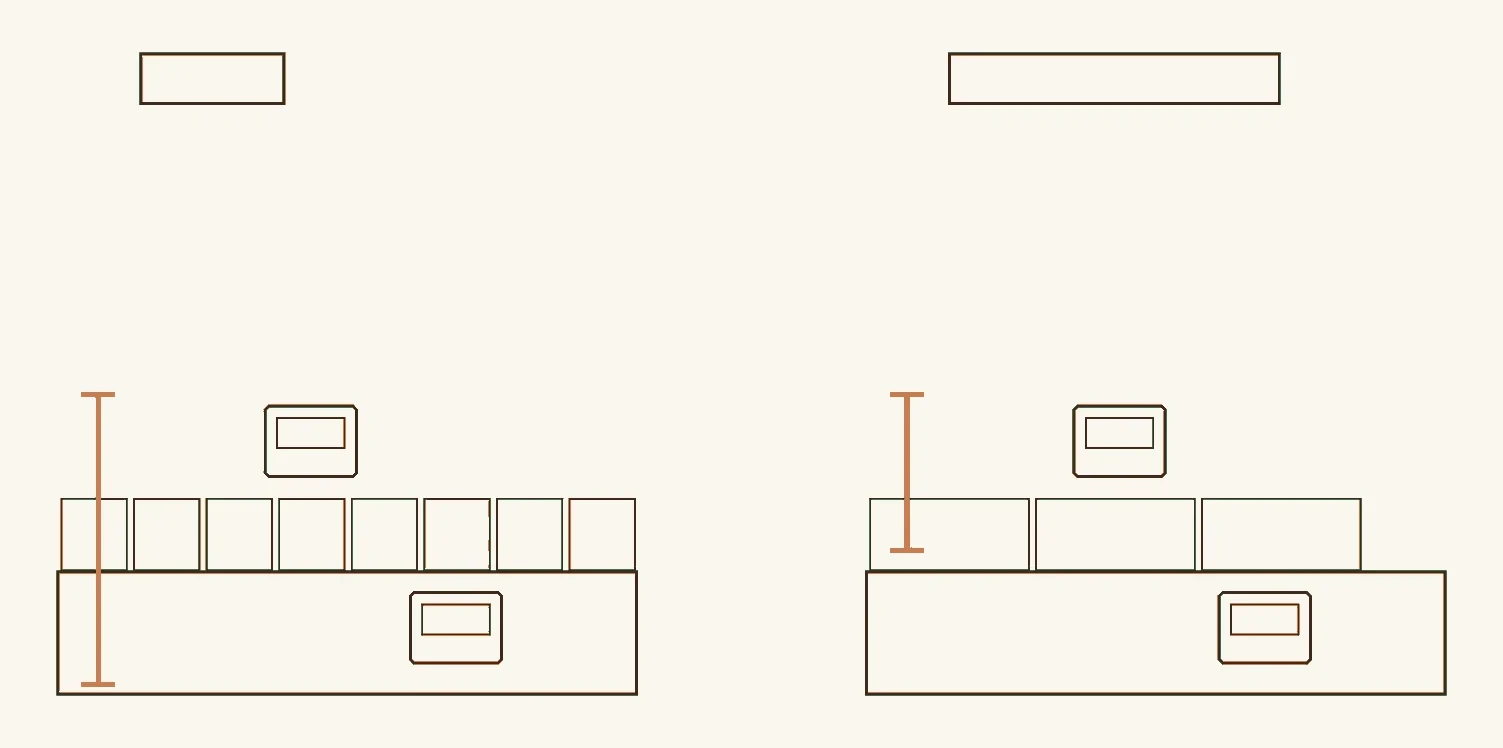
The standard also fixes the vocabulary that quotes use loosely. Unfinished solid flooring thickness is .750 inches, or 19.05 mm, with a tolerance of plus or minus .015 inches — .38 mm.
Width names are defined, not descriptive. Strip is less than 3 inches, or 76.2 mm. Plank is 3 to 5 inches. Wide plank is greater than 5 inches. A showroom describing a 4-inch board as wide plank is using a word the standard has already defined differently.
| Term | Definition |
|---|---|
| Thickness | .750" (19.05 mm), ± .015" (.38 mm) |
| Strip | Less than 3" (76.2 mm) |
| Plank | 3" to 5" |
| Wide plank | Greater than 5" |
Engineered construction, and the refinishable thresholds
The Environmental Product Declaration published jointly by the Decorative Hardwoods Association and the NWFA describes engineered wood flooring as normally made using multiple wood veneers or slats of wood glued together under pressure at opposing directions, or a variety of composites for core material such as MDF, with a finished thickness ranging from 3/8 inch to 3/4 inch.
The same document records that red oak and white oak are the dominant species in the US hardwood forests and therefore comprise the majority of engineered hardwood flooring production — which is the clearest published statement available of why the engineered market looks the way it does.
The number that decides whether an engineered floor is an asset or a consumable is the wear layer. The NWFA Refinishable programme sets the thresholds: 3.2 mm — 4/32 inch — for unfinished smooth, 2.5 mm — 3/32 inch — for factory-finished smooth, and 2.5 mm at the lowest point for sculpted or distressed product. Refinishing is defined there as sanding a previously finished floor to bare wood and applying new stain or finish.
What is not published anywhere we could find is how many refinishing cycles an engineered floor supports. The NWFA’s own article declines to quantify it: it notes that a sanding removes about 1/32 inch and that the floor remains refinishable once more, and stops. Anyone quoting you a cycle count is quoting themselves.
| Product | Minimum wear layer |
|---|---|
| Unfinished, smooth | 3.2 mm (4/32") |
| Factory-finished, smooth | 2.5 mm (3/32") |
| Sculpted or distressed | 2.5 mm (3/32") at the lowest point |
What the core is certified to
An engineered board has a core, and the core is a composite panel governed by emissions law rather than by flooring rules.
Under US TSCA Title VI, based on test method ASTM E1333-14, the limits are 0.05 ppm for hardwood plywood with a veneer or composite core, 0.11 ppm for medium-density fibreboard, 0.13 ppm for thin MDF and 0.09 ppm for particleboard, applying to product sold, supplied, offered for sale or manufactured — including imported — on or after 1 June 2018 in the United States. The EPA states that it worked with the California Air Resources Board to help ensure the final national rule was consistent with California’s requirements.
ANSI/HPVA HP-1-2024, approved 20 August 2024, covers the principal types, face grades, back grades, inner ply grades and constructions of plywood made primarily with hardwood faces, describing constructions with an odd number of plies where all inner plies except the innermost occur in pairs. Its scope does not name flooring.
We found no Canadian federal instrument setting an equivalent formaldehyde limit, and we do not assert that TSCA Title VI binds product sold in Canada. Ask for the certificate.
What applies in Canada
The Canadian Hardwood Bureau states that hardwood lumber grading standards in Canada are published and overseen by the National Hardwood Lumber Association. For flooring, the operative evidence is behavioural: Canadian mills certify to the American standard.
The NWFA lists Lauzon Distinctive Hardwood Flooring of Papineauville, Quebec as a NOFMA-certified manufacturer of unfinished solid and factory-finished solid flooring, and Superior Hardwood Flooring / Herwynen Saw Mill Ltd. of Rockwood, Ontario as a NOFMA-certified factory-finished solid manufacturer. NWFA/NOFMA-certified flooring, in its own words, is made by NWFA manufacturing members that have pledged to uphold the NWFA/NOFMA standards.
On the evidence we have, both bodies are voluntary trade-association standards in Canada, and we found no statute or regulation making either mandatory. That is not a reason to ignore them. It is a reason to require them by name in the contract, because nothing else will.
Reading a grade on a quote
Six checks, in the order they matter. Any competent supplier can answer all six in one email.
- Does the quote name the species botanically — red oak or white oak, not "oak"?
- Does it name a flooring grade under NWFA/NOFMA — Clear, Select, No. 1 Common or No. 2 Common — rather than an invented marketing tier?
- Does it state a thickness and a width, and does the width name match the standard’s definitions of strip, plank and wide plank?
- For engineered: does it state the wear layer at its thinnest point in millimetres, and does that meet 3.2 mm unfinished or 2.5 mm factory-finished?
- For engineered: does it name the emissions standard the core is certified to, and who certified it?
- Does it name the manufacturer and the mill, so that every answer above can be checked against a document rather than a salesperson?
Sources
Every figure in this paper was read from the document below, on the date shown beside it. An external page can change under a citation, so the read date is recorded rather than implied.
- National Hardwood Lumber AssociationRules for the Measurement & Inspection of Hardwood & Cypress (effective 1 January 2023)Read August 27, 2026
- National Hardwood Lumber AssociationNHLA grading rulesRead August 27, 2026
- Canadian Hardwood BureauGradingRead August 27, 2026
- National Wood Flooring AssociationNWFA/NOFMA International Standards for Unfinished Solid Wood Flooring, revised April 2018Read August 27, 2026
- National Wood Flooring AssociationNWFA Engineered Wood Flooring Refinishable Program, Hardwood Floors magazine, Aug/Sept 2022Read August 27, 2026
- National Wood Flooring AssociationNWFA/NOFMA certified manufacturersRead August 27, 2026
- Decorative Hardwoods Association and National Wood Flooring AssociationEnvironmental Product Declaration for Engineered Wood Flooring (2022-11-25)Read August 27, 2026
- Decorative Hardwoods Association / ANSIANSI/HPVA HP-1-2024, approved 20 August 2024Read August 27, 2026
- US Environmental Protection Agency / eCFR40 CFR § 770.10 — Formaldehyde emission standardsRead August 27, 2026
- US Environmental Protection AgencyFormaldehyde emission standards for composite wood productsRead August 27, 2026