
Why provenance is a specification question, not a sentiment
Provenance usually arrives in flooring conversations as a feeling: local is good, imported is suspect, sustainable is a logo. None of that survives contact with a floor that has to hold a Toronto winter for thirty years.
Provenance is a specification question for three concrete reasons. The species available to you is set by what grows and what is cut, and that is a published number, not a preference. The grade you are sold is set by a rulebook written by a body that is not your contractor. And the moisture content the boards arrive at is set at the mill, before anyone in your house has a say in it — the NWFA standard puts that at 6% to 9% moisture content, with a 5% allowance for pieces outside that range up to 12%.
Everything downstream of those three facts is negotiable. None of the three is. So the honest way to talk about where your floor comes from is to go and read what the forest service, the grading bodies and the mills actually publish, and to say plainly where that record stops.
The Ontario forest, in the numbers the province publishes
Ontario publishes its forest inventory, and it is very large. The province states that Ontario has 70.4 million hectares of forest, which it puts at 4.8 hectares of forest for every Ontarian. A second provincial page, updated more recently, states 70.5 million hectares and 66% of Ontario. We publish both and average neither; the discrepancy is the province’s, not ours.
The harvest is a small fraction of the standing resource and a fraction of what is permitted. Over 2009 to 2019, on average 121,000 hectares was harvested per year resulting in 13 million cubic metres of wood, which the province records as 44% of the approved area and volume that was available to harvest. In 2024, 113,000 hectares of forest was harvested, representing 40% of the approved area, yielding 11.4 million cubic metres.
Almost none of that is your floor. Ontario’s 2024 harvest by species was spruce 41%, jack pine 28% and poplar 16% — softwoods and a pulpwood hardwood, cut principally for lumber and pulp. The hardwoods that become flooring live in the residual, which the province does not break out.
| Ownership category | Area |
|---|---|
| Managed Crown forest | 27.8 million hectares |
| Unmanaged Crown forest | 15.8 million hectares |
| Parks and protected areas | 6.1 million hectares |
| Private and other | 6.6 million hectares |
The seven tolerant hardwoods — and which flooring species are not on the list
Ontario groups the hardwoods that hold a closed canopy as "tolerant hardwoods", and its silvicultural guide names seven principal species: sugar maple, American beech, yellow birch, red oak, white ash, black cherry and basswood. The 1998 guide describes them as distributed on more than 3.6 million hectares with a gross total volume of 562 million cubic metres, including hemlock. The 2021 provincial inventory records the tolerant hardwood forest type at 2,565,209 hectares, of which 1,215,664 hectares are Crown managed.
Those two extents are twenty-three years apart, measured on different bases, and they are not reconcilable from the documents themselves. We quote both.
Read that species list against the six hardwoods a Toronto homeowner is actually shown, and the interesting result is what is missing. Red oak, hard maple and white ash are principal Ontario tolerant hardwoods. White oak, hickory and black walnut are not on that list — all three grow in Ontario, and Ontario’s own tree atlas says so, but none is a named principal commercial tolerant hardwood and none appears as a separate line in the growing-stock table we read.
That is evidence of non-prominence. It is not evidence of zero harvest, and we decline to convert the one into the other.
- White oak is found in Southern Ontario; Ontario lists its wood use as lumber for furniture and flooring.
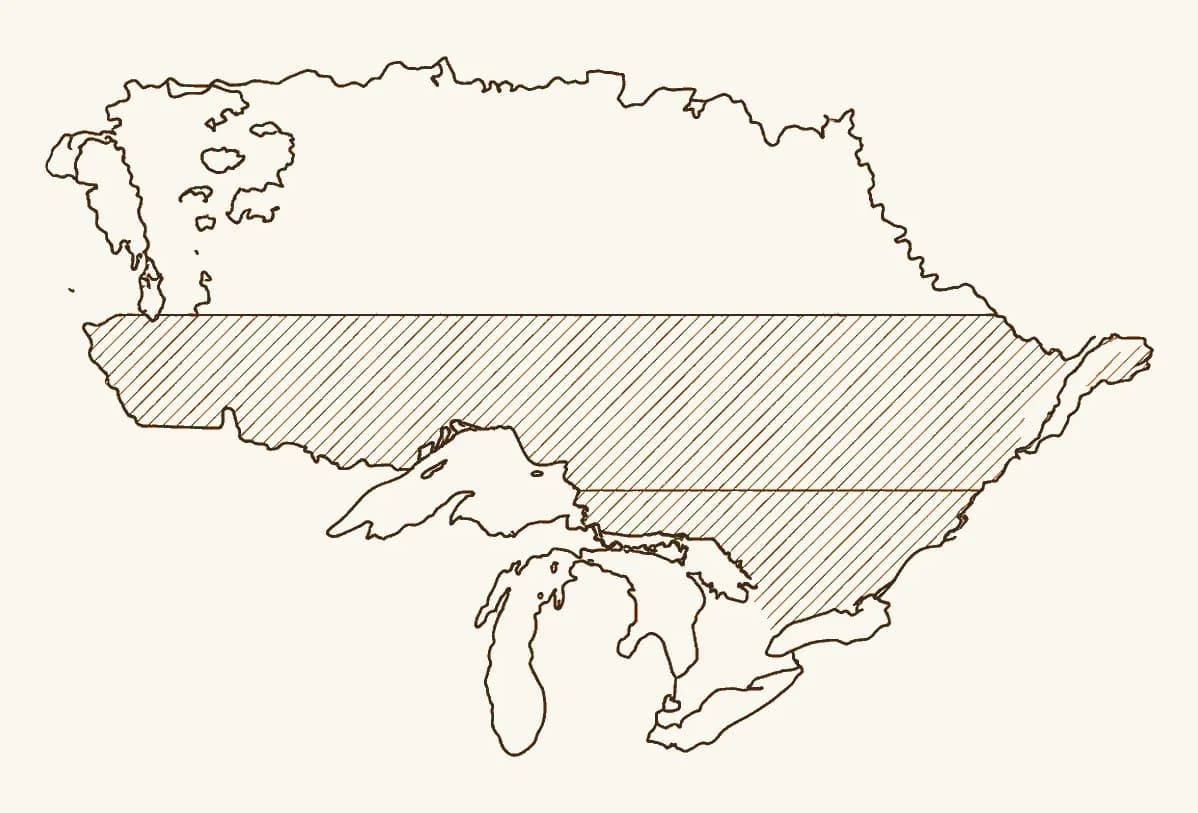
- Red oak is found east of Lake Superior and across Central and Southern Ontario.
- Sugar maple is found in Central, Southern and parts of Northwestern Ontario, and Ontario names flooring as a use.
- White ash is found throughout Southern Ontario and north to Lake Nipissing and Sault Ste. Marie.
- Shagbark hickory grows in Southern Ontario, including along the St. Lawrence River and into Quebec.
- Black walnut is a common species in moist, low-lying areas in Southwestern Ontario, often planted beyond its range.
Growing stock, by species
Growing stock is the volume of wood standing in the forest. Ontario publishes it by species, and the ordering is the single most useful provenance fact available to an Ontario homeowner, because it says which species the province could keep supplying without importing anything.
Sugar maple dominates: 300,361,212 cubic metres, the largest of any Ontario flooring hardwood, and the province separately describes it as roughly 3% of Ontario’s managed forest and the most common tree in the Great Lakes–St. Lawrence and Deciduous Forest regions. Red oak follows at 85,019,702 cubic metres and yellow birch at 82,005,013. Ash, as a group, stands at 42,273,003 and basswood at 18,444,080.
For scale rather than for flooring: white birch is recorded at 475,521,667 cubic metres and poplar at 1,187,029,219. Those are pulp and panel species, and their size is a reminder that the flooring hardwoods are a minority interest inside a working forest built around something else.
| Species | Gross total volume | Used for flooring in the GTA |
|---|---|---|
| Sugar maple | 300,361,212 m³ | Yes — hard maple |
| Red oak | 85,019,702 m³ | Yes |
| Yellow birch | 82,005,013 m³ | Occasionally |
| Ash (group) | 42,273,003 m³ | Yes — under decline pressure |
| Basswood | 18,444,080 m³ | No |
How Ontario cuts them: the selection system
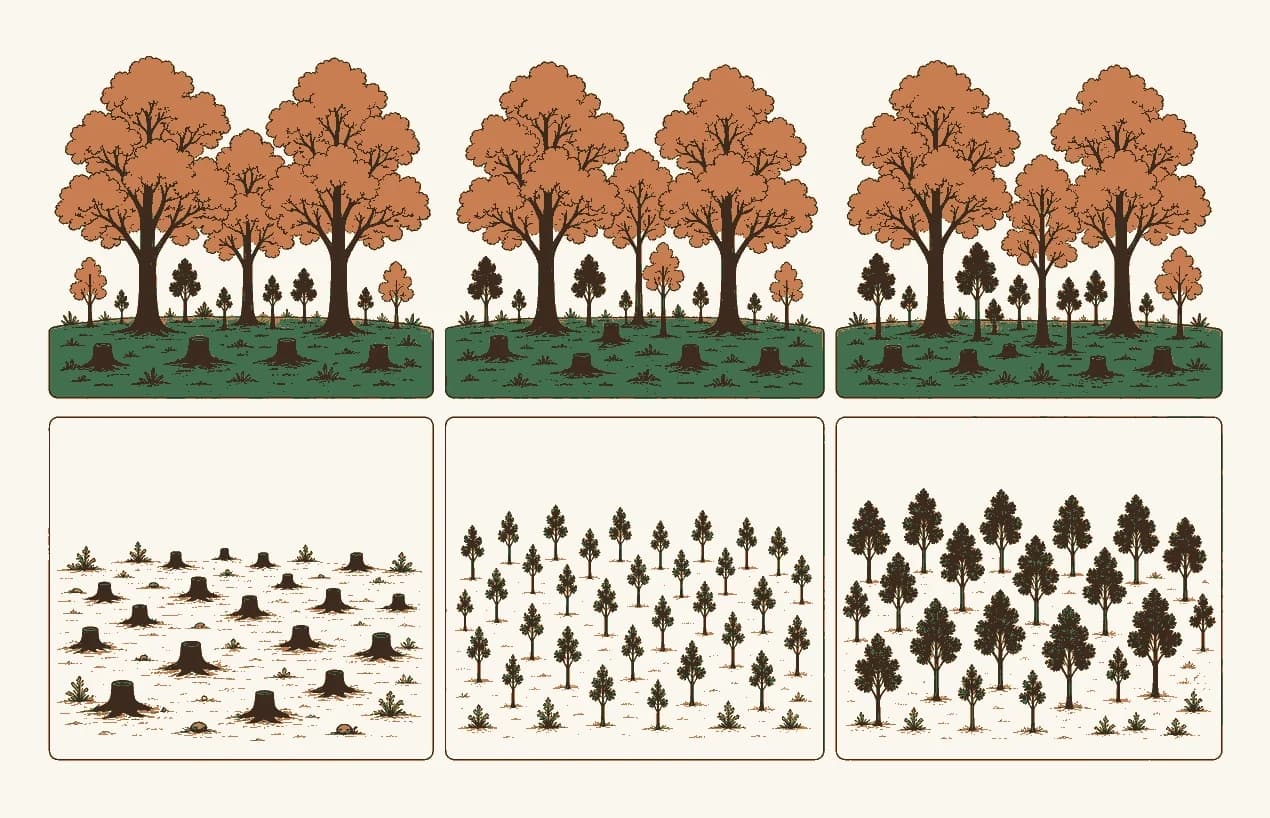
Tolerant hardwood is not clear-cut in Ontario. The province’s silviculture guide defines the selection system as periodic partial harvests timed on basal-area recruitment, using vigour, risk and species preference to choose which trees are taken and which are kept.
The result it specifies is an all-aged future forest, with regeneration established under at least 70% residual cover — roughly 30% or less full sunlight — and dense mature forest cover maintained in perpetuity. The same guide records that residual trees in a selection harvest may be retained for multiple cutting cycles totalling 100 years or more.
Sugar maple is described by the province as amenable to the single-tree selection silvicultural system, which is one reason it is both the largest growing stock and a species that can be cut without opening the canopy.
This matters to a floor for an unromantic reason. A stand managed on 100-year cutting cycles produces slow, even growth, and slow even growth is what produces the tight, consistent grain that grades well and machines well. The silviculture and the grade are the same fact seen at two ends of the chain.
Where the mills are: Quebec, and one in Ontario
The heaviest hardwood-flooring manufacturing capacity serving the Greater Toronto Area is in Quebec, and it is vertically integrated — the same company owns the sawmill, the kilns and the finishing line.
Mercier states that it has been vertically integrated for over twenty years, that its Drummondville, Quebec sawmill provides its own raw lumber and houses kiln drying units and production lines, and that Montmagny handles finishing from stain application to delivery. Lauzon, founded 1985 at Papineauville, operates five Quebec sites and describes its Thurso sawmill as the largest hardwood sawmill in Canada. Preverco, founded 1988, runs a sawmill at Daveluyville with plants at Boisbriand and Saint-Augustin-de-Desmaures. Mirage has manufactured since 1983; Wickham has been in business over thirty-five years.
Ontario contributed exactly one named flooring manufacturer to this search. Superior Flooring, trading as Herwynen Sawmill Limited, mills at Rockwood, Ontario, began in 1986 producing rough-cut lumber on land severed from the family farm, and lists five species: ash, hickory, maple, red oak and white oak.
The most completely traceable Toronto supply chain we could document runs entirely inside Ontario: Herwynen mills and prefinishes at Rockwood, the NWFA lists Superior Hardwood Flooring / Herwynen Saw Mill Ltd. as a NOFMA-certified factory-finished solid manufacturer, and the brand appears stocked at Canadian Flooring on Steeles Avenue West in North York. Every link in that chain is on a page we opened. What no source anywhere told us is where Herwynen’s logs come from.
| Manufacturer | Sawmill | Other plants | Stated since |
|---|---|---|---|
| Mercier | Drummondville, QC | Montmagny, QC (finishing) | Founded over 45 years ago |
| Lauzon | Thurso, QC | Maniwaki, Papineauville, Saint-Norbert, QC | 1985 |
| Preverco | Daveluyville, QC | Boisbriand, Saint-Augustin-de-Desmaures, QC | 1988 |
| Mirage (Boa-Franc) | Not stated on the page read | Quebec | 1983 |
| Superior / Herwynen | Rockwood, ON | Rockwood, ON (prefinishing) | 1986 |
Log to floor: the chain, reconstructed
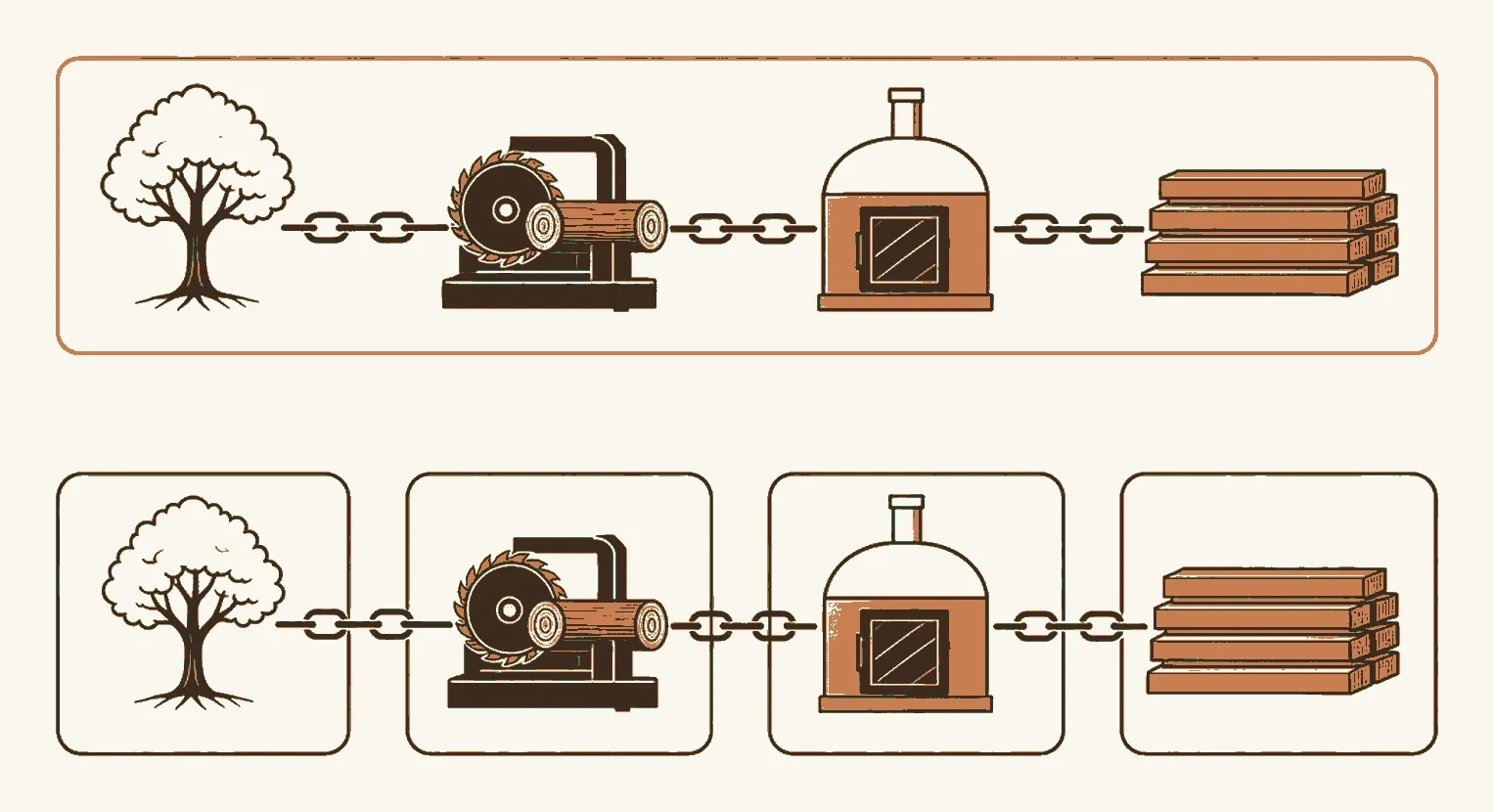
No single publication describes the Canadian log-to-floor chain end to end. We looked. What exists is each company’s account of its own segment, plus the Quebec Wood Export Bureau’s process listings — sawing, kiln drying, planing and container loading — across more than 125 manufacturers.
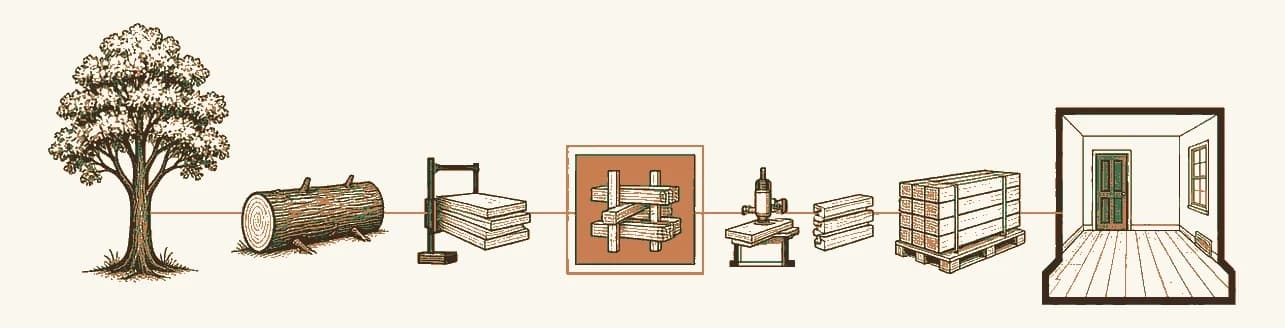
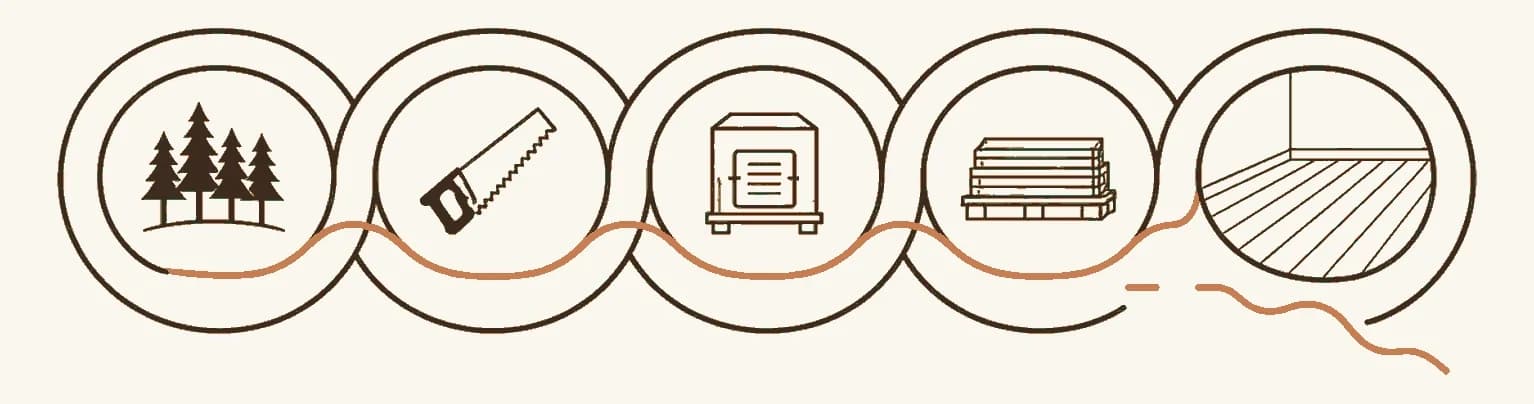
Assembled from those disclosures, the chain has six links, and a floor can fail at any of them before a contractor ever sees it.
- Standing timber, cut under a silvicultural system — in Ontario tolerant hardwood, the selection system, on cutting cycles measured in decades.
- Sawmill: the log is broken down into boards, and the NHLA yield grade of each board is fixed here and never improves afterwards.
- Kiln: the boards are dried to a target moisture content. The NWFA standard puts manufactured flooring at 6% to 9% moisture content.
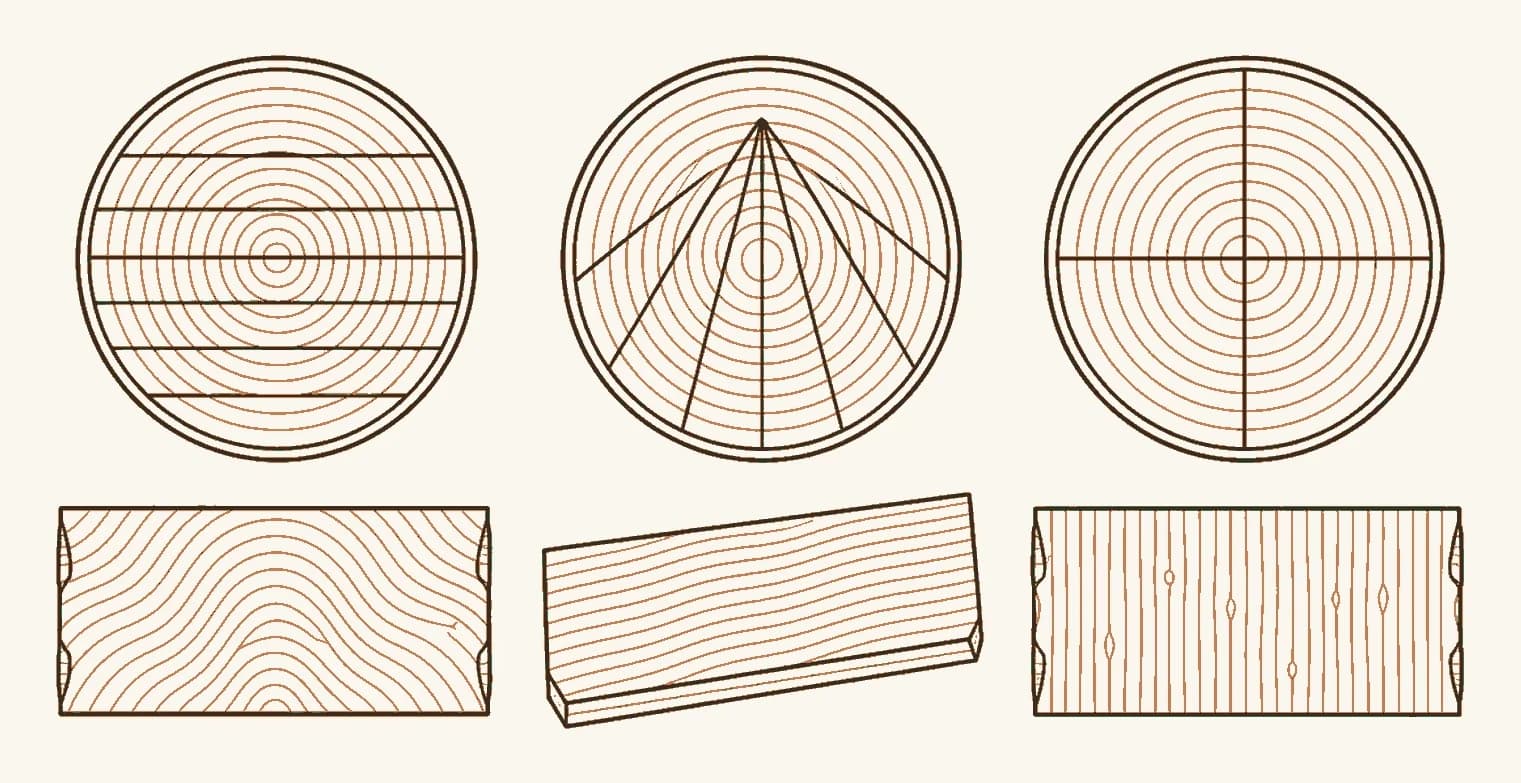
- Flooring mill: boards are milled to profile — tongue, groove and back relief — and graded a second time, on appearance, under the NWFA/NOFMA rules.
- Finishing line or unfinished pack-out, then distribution to a regional wholesaler.
- Site: acclimation to the actual building, moisture testing of the subfloor, and installation. This is the first link the homeowner controls, and the last one that can save the five before it.
Certification, legality and what the marks actually certify
Canada certifies a very large share of its forest. The Forest Products Association of Canada publishes 154 million hectares of certified forest land in Canada across FSC, PEFC and SFI, puts Canada at 38% of the world’s certified forest, and notes that 10% of the world’s forests are certified at all.
In Ontario, the provincial picture is published as unit counts rather than hectares. As of December 2020, 26.1 million hectares were certified — 29 of 39 management units, equating to 77% of the public lands and waters within management units. Of those: 13 units FSC, 9 SFI, 6 dual FSC and SFI, 1 CSA, and 10 uncertified.
Legality is a separate instrument from sustainability. Canada’s Wild Animal and Plant Protection and Regulation of International and Interprovincial Trade Act prohibits the import of plant products taken or transported in contravention of foreign law; the United States Lacey Act prohibits trade in illegally sourced timber products. Natural Resources Canada states plainly that the risk of illegal logging is negligible in all regions of Canada.
For engineered flooring, the relevant instrument is an emissions limit on the core rather than a forest mark. Under US TSCA Title VI, tested to ASTM E1333-14, hardwood plywood is limited to 0.05 ppm formaldehyde, medium-density fibreboard to 0.11 ppm, thin MDF to 0.13 ppm and particleboard to 0.09 ppm, for product sold, supplied, offered for sale or manufactured on or after 1 June 2018 in the United States. The EPA states it worked with the California Air Resources Board so the national rule was consistent with California’s.
The one species being cut faster than it grows
Across the six hardwoods used for flooring in this market, five show annual growth at roughly double annual harvest in the American Hardwood Export Council’s inventory: red oak 60.6 against 31.9 million cubic metres a year, white oak 40.1 against 20.1, hard maple 19.1 against 10.2, hickory 14.6 against 6.0, black walnut 4.8 against 1.9.
White ash is inverted. Growth 3.3 million cubic metres a year against harvest 6.9. It is the only one of the six in that position.
The reason is not demand. The emerald ash borer was first detected near Detroit, Michigan and Windsor, Ontario in 2002, and up to 99% of ash trees are killed within eight to ten years of its establishment. Standing ash is being salvaged ahead of an insect, and the harvest figure is what that salvage looks like in a table.
The specification consequence is narrow and real. Ash is a beautiful, hard, pale floor at 1,320 lbf. It is also the one species in this set whose supply is contracting for a reason unrelated to how well it performs, and a homeowner choosing it should be told that rather than discovering it at the reorder.
What nobody publishes
This is the section that makes the rest of the paper worth reading. Everything below was searched for and not found in any document we could open. It is published deliberately, because the alternative — filling the gaps with plausible sentences — is what the rest of this industry does.
- Ontario’s annual hardwood harvest volume. The province publishes the total and a species split covering spruce, jack pine and poplar only; the residual is not broken out.
- An Ontario annual allowable cut for hardwood specifically. Only an undifferentiated percentage of approved area is published.
- The Crown-versus-private split of Ontario hardwood harvest volume. The area split exists; the volume split does not.
- Cutting-cycle length in years for Ontario tolerant hardwood selection harvest. The 2019 guide says only "multiple cutting cycles totalling 100+ years".
- Residual basal-area targets in square metres per hectare after selection harvest in Ontario.
- FSC-certified and SFI-certified hectares in Ontario. Only unit counts are published.
- The proportion of hardwood flooring sold in Canada that is imported versus domestically manufactured. No flooring sub-industry is broken out under NAICS 321, and every remaining source was a paywalled market-research vendor.
- Any dataset of GTA or Ontario installed flooring by species.
- Any authority for the very common claim that red oak dominates Ontario housing stock historically. We found abundant blog content asserting it and no source. We do not publish it.
- Ontario growing-stock volumes for white oak, hickory and black walnut, and whether they are commercially harvested in Ontario at all.
- A Canadian federal formaldehyde emission limit for composite wood cores.
- Published wear-layer thickness ranges for engineered flooring, as distinct from the refinishable thresholds.
- How many refinishing cycles an engineered floor supports. The NWFA’s own article declines to quantify it.
- Kiln schedules or drying times for Ontario hardwood.
- Any statute or regulation making NHLA or NWFA rules mandatory in Canada. On the evidence we have, both are voluntary trade-association standards.
What to ask, before you buy
Provenance becomes useful the moment it turns into a question a supplier has to answer in writing. These are the six that change what arrives on your floor.
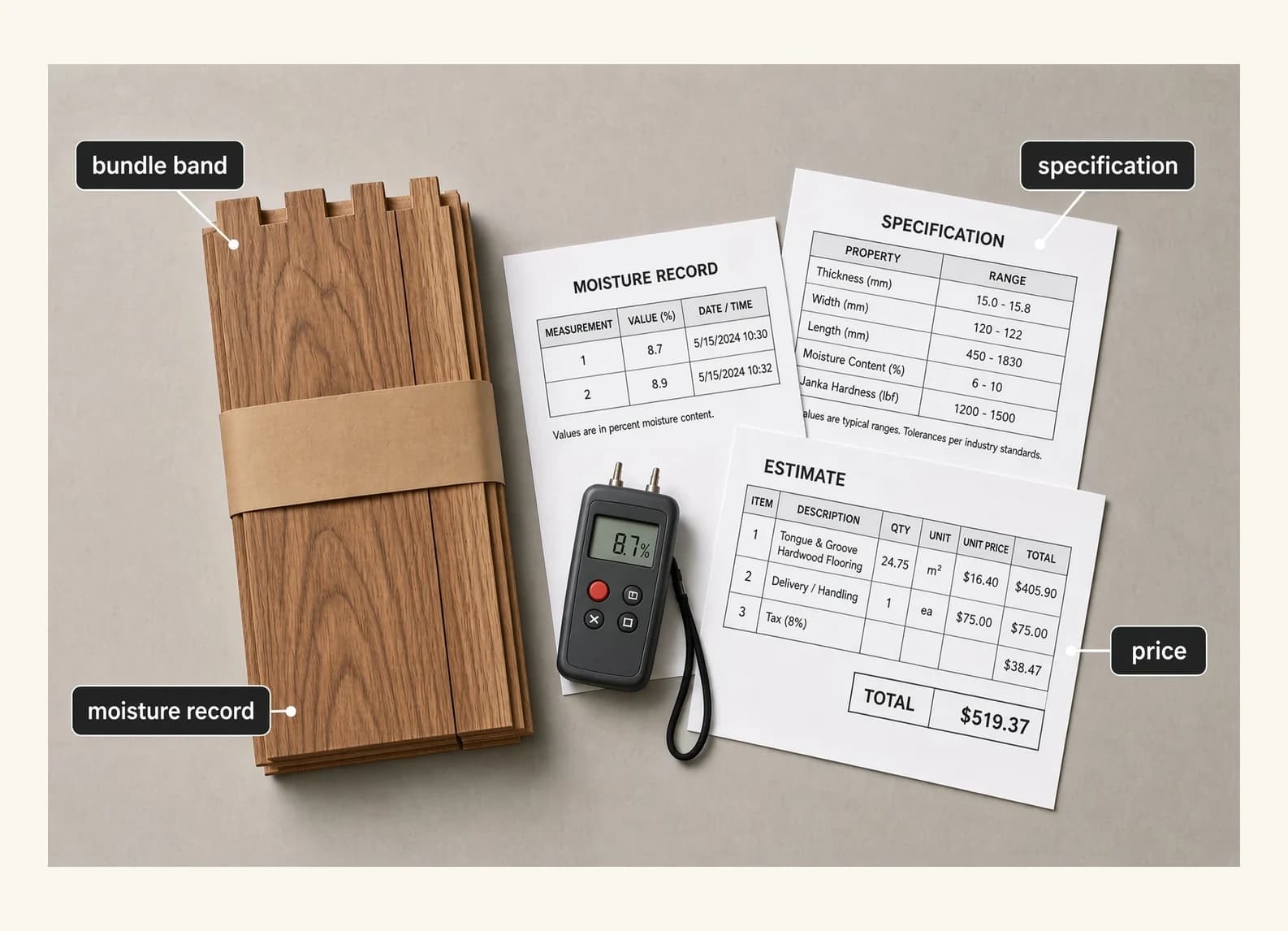
- Which species, botanically — not "oak" but red oak or white oak. They are different woods with different hardness, different grain and different supply.
- Which flooring grade, under which rulebook, named on the quote. NWFA/NOFMA Clear, Select, No. 1 Common and No. 2 Common are appearance grades with published permissions.
- What moisture content the material leaves the mill at, and what it reads on arrival at your house.
- For engineered: the wear-layer thickness at its thinnest point, and whether the product meets the NWFA refinishable thresholds of 3.2 mm unfinished or 2.5 mm factory-finished.
- For engineered: which emission standard the core is certified to, and by whom.
- Who milled it and where. A vertically integrated manufacturer can answer this in one sentence; a repackager cannot answer it at all.
Sources
Every figure in this paper was read from the document below, on the date shown beside it. An external page can change under a citation, so the read date is recorded rather than implied.
- Government of Ontario, Ministry of Natural ResourcesState of Ontario's Natural Resources — Forest 2021Read August 27, 2026
- Government of OntarioForest management facts and figuresRead August 27, 2026
- Government of OntarioForest Resources of Ontario 2021 — Ontario's landbaseRead August 27, 2026
- Government of OntarioForest Resources of Ontario 2021 — Growing stock volumesRead August 27, 2026
- Ontario Ministry of Natural ResourcesA Silvicultural Guide for the Tolerant Hardwood Forest in OntarioRead August 27, 2026
- Ontario Ministry of Natural ResourcesForest Management Guide to Silviculture in the Great Lakes–St. Lawrence and Boreal Forests of OntarioRead August 27, 2026
- Ontario Biodiversity CouncilState of Ontario's Biodiversity — Forest certificationRead August 27, 2026
- Forest Products Association of CanadaForest management certificationsRead August 27, 2026
- Natural Resources CanadaLegality and sustainability of Canadian forest productsRead August 27, 2026
- US Environmental Protection Agency / eCFR40 CFR § 770.10 — Formaldehyde emission standardsRead August 27, 2026
- American Hardwood Export CouncilA Guide to Sustainable American HardwoodsRead August 27, 2026
- Invasive Species CentreEmerald ash borerRead August 27, 2026
- Quebec Wood Export BureauHardwood Lumber & Flooring Manufacturer Directory, October 2025Read August 27, 2026
- National Wood Flooring AssociationNWFA/NOFMA certified manufacturersRead August 27, 2026