
How much will your floor move?
Every flooring company in this city will tell you that wood moves with the seasons. None of them will tell you how much yours will. This does — from the same coefficients a wood scientist would use, for the species and the board width you are actually being quoted, over the humidity range a Toronto house actually reaches.
The arithmetic runs in your browser. Nothing is submitted, nothing is stored, and there is no form between you and the answer. The coefficients come from Wood Handbook (FPL-GTR-190) Table 13–5 and the moisture-content model from Wood Handbook (FPL-GTR-190) equation 4–5, Hailwood–Luikov as fitted by Simpson. Neither is ours. That is the point — you can check them.
Each board moves
2.60 mm
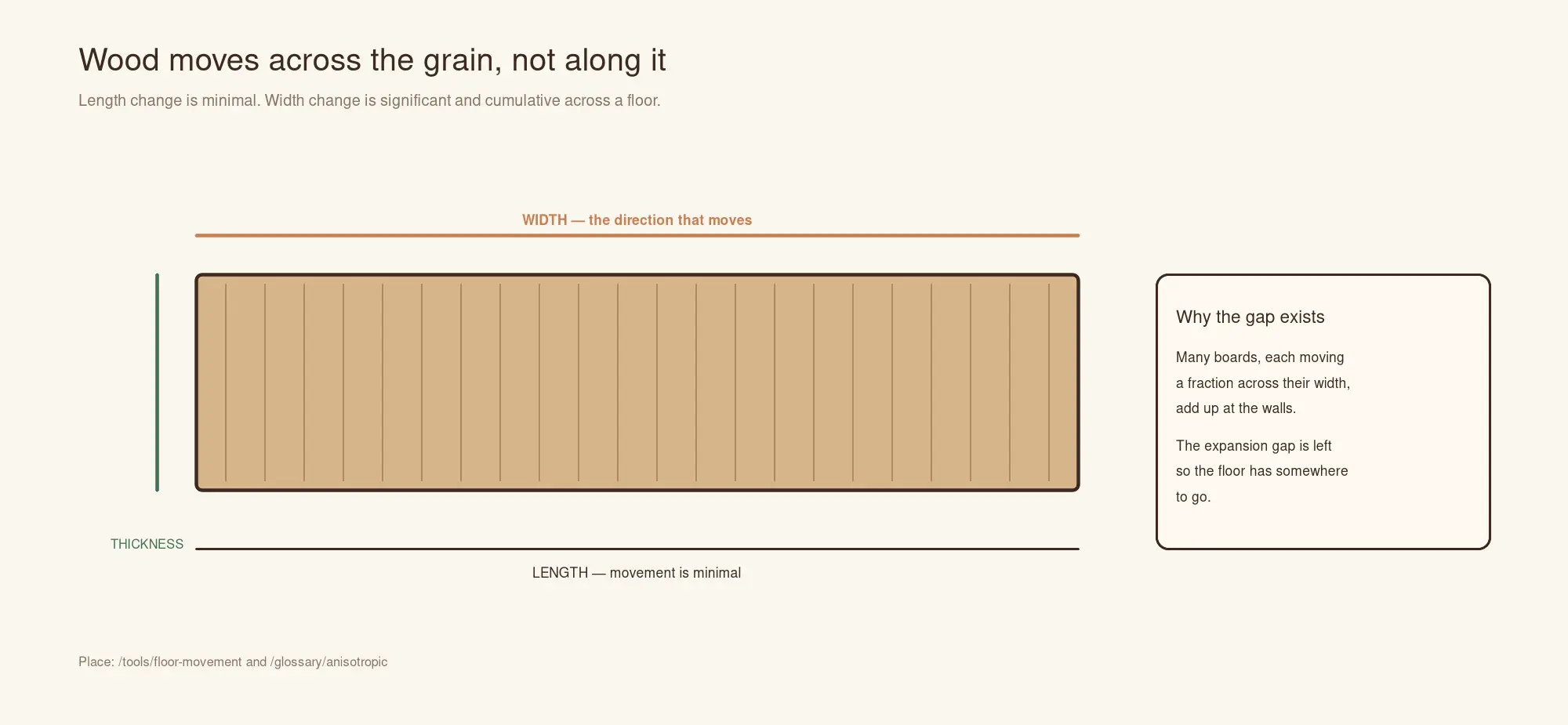
across its width, between 25% and 60% RH — that is 2.05% of the board.
- Moisture content, winter
- 5.4%
- Moisture content, summer
- 11.0%
- Swing
- 5.6 points
- Boards across 4 m
- 31
- Total the floor absorbs
- 80.61 mm
- Flatsawn vs quartersawn
- 2.03×
- The published coefficients are valid from 6% to 14% moisture content. This range reaches 5.4%–11.0%, so the figure is an extrapolation at one end and understates what a floor in those conditions really does.
- “White oak” is a commercial group in the source table rather than a single botanical species. Individual boards vary around the group value.
This is unrestrained movement in solid wood. A real floor is fastened and restrained, so the total does not appear at one seam — it is the amount the installation has to absorb somewhere. Engineered flooring is not modelled here: its cross-ply core exists to defeat this calculation.
The comparison nobody publishes
All nine, at 127 mm wide, in your conditions
| Species | Flatsawn | Quartersawn | Ratio |
|---|---|---|---|
| Black cherry | 1.77 mm | 0.90 mm | 1.97× |
| Black walnut | 1.95 mm | 1.35 mm | 1.44× |
| White ash | 1.95 mm | 1.20 mm | 1.62× |
| Pecan hickory | 2.24 mm | 1.20 mm | 1.86× |
| Yellow birch | 2.41 mm | 1.82 mm | 1.32× |
| Hard maple | 2.51 mm | 1.18 mm | 2.14× |
| White oak | 2.60 mm | 1.28 mm | 2.03× |
| Red oak | 2.63 mm | 1.13 mm | 2.34× |
| True hickory | 2.93 mm | 1.85 mm | 1.59× |
Coefficients: Wood Handbook (FPL-GTR-190) Table 13–5, per 1% moisture content change, valid 6%–14% MC. Moisture content: Wood Handbook (FPL-GTR-190) equation 4–5, Hailwood–Luikov as fitted by Simpson. Both are United States Forest Products Laboratory publications, and this page’s implementation of them is asserted against Wood Handbook (FPL-GTR-190) Table 4–2 in the test suite — if the physics ever stops agreeing with the published values, the build fails.
What this changes
Three things this number is good for
- Judging a width. A wide plank is not simply a style choice — it moves proportionally more, because movement scales with the dimension. Set the slider to the width you are being quoted and the width you were considering, and the difference is the number nobody put in the quote.
- Judging a species. The comparison table above is the same nine woods every showroom sells, ranked by how much they move rather than by colour.
- Judging a contractor. Ask whichever company quoted you what the expansion gap is, and what moisture content the material will read at delivery. The Well-Installed Framework turns that into 27 questions you can put in writing — including to us.
The physical constants above describe unrestrained solid wood. What an installed floor does with that movement depends on the substrate, the fastening method, the expansion gaps and how well the material was acclimated — which is the subject of Climate Mastery.