
Decision guide
Nail-down, glue-down or floating hardwood installation in Toronto
Which hardwood installation method is correct for my subfloor?
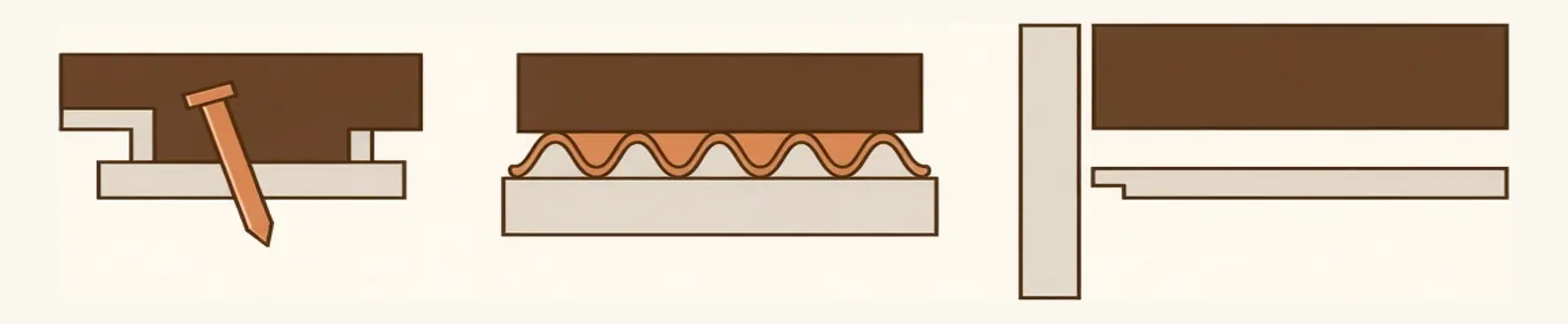
Installation method is not a preference and not a sales option. It is determined by the substrate, the product construction, and the climate load the floor will face for decades.
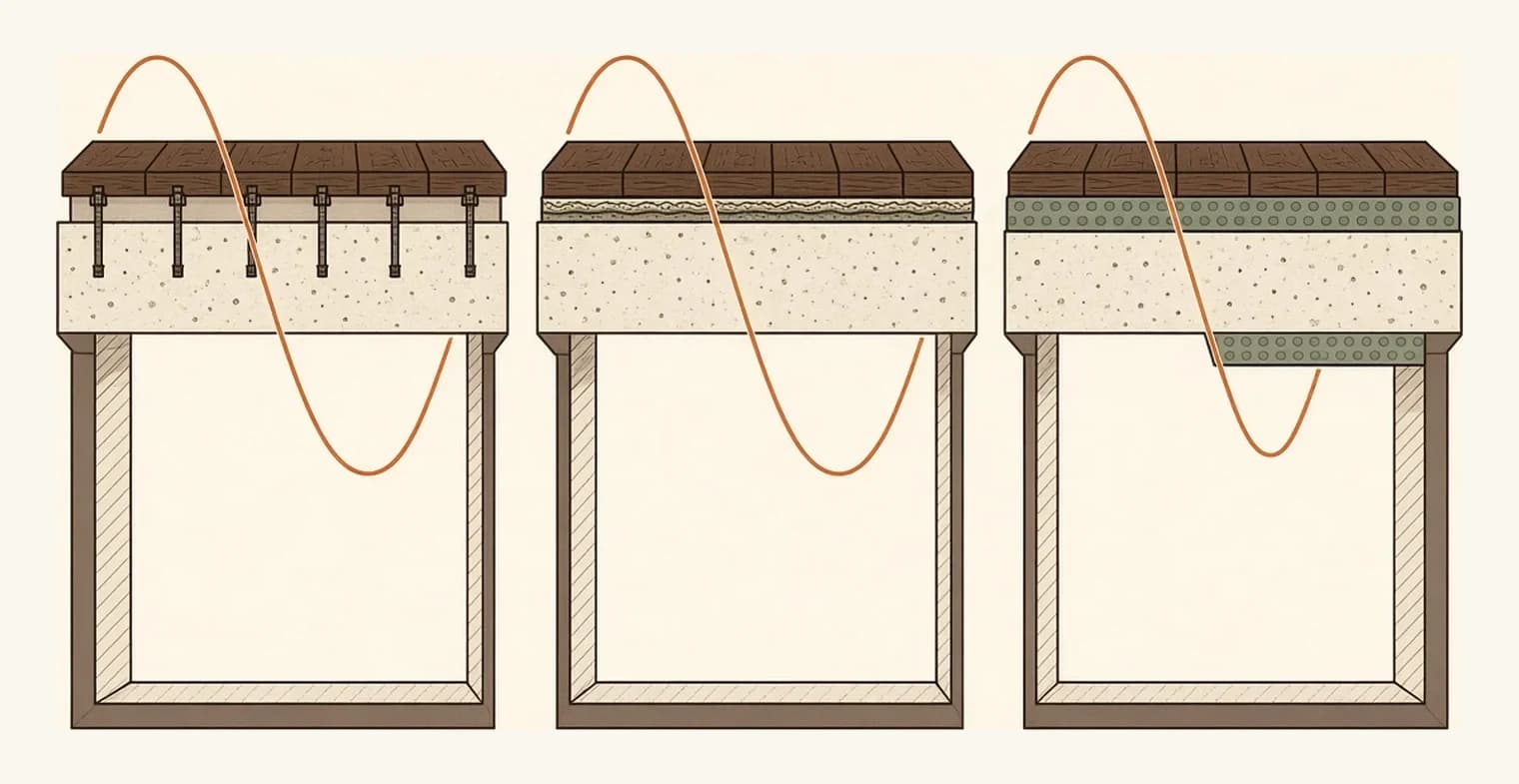
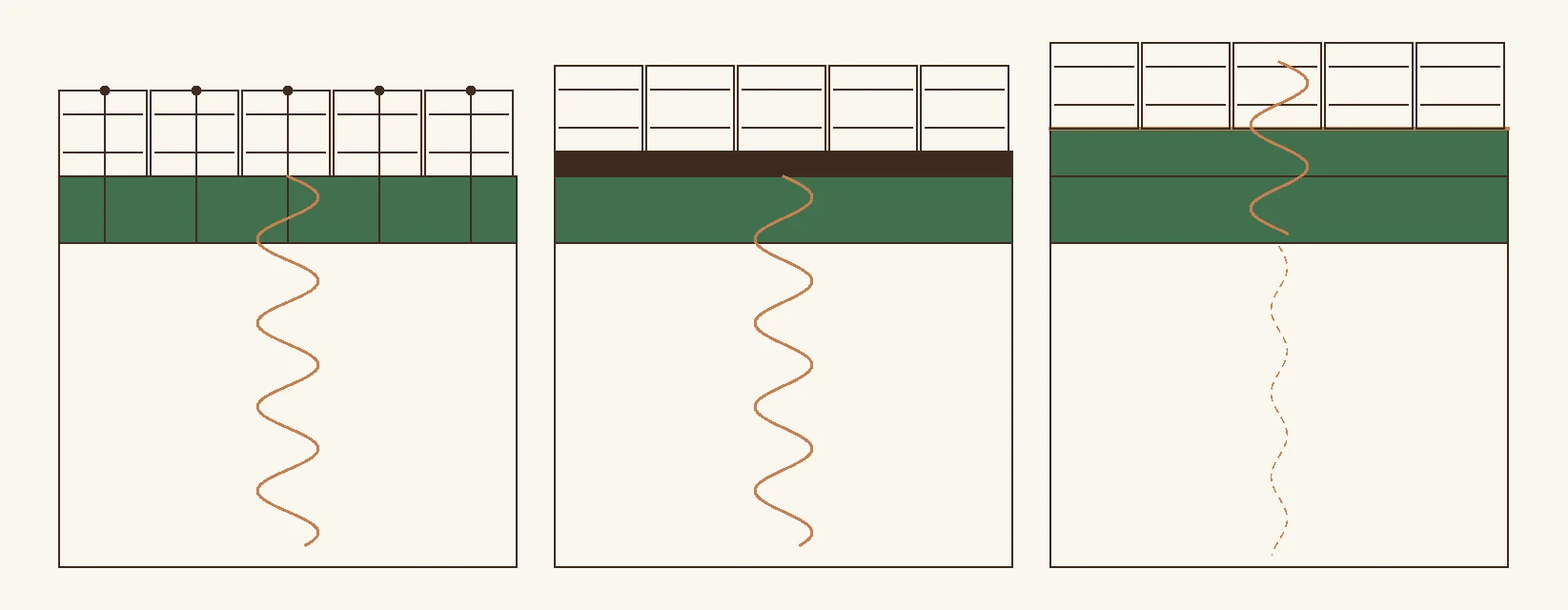
The fixing method decides what the neighbour below hears. A floating assembly is the one that introduces a break between the finished floor and the structure — which is why condominium rules usually specify it.View full size — Three floor assemblies in section over a concrete slab with the unit below shown, comparing how sound travels through nailed, glued and floating construction.
First
What actually decides this
What the floor is going onto
Plywood accepts fasteners. Concrete does not. Radiant assemblies constrain both fastening and adhesive choice.
Product construction
Solid and engineered do not accept the same methods. The construction and the substrate must agree before a method is chosen.
Acoustic requirements
Condominium boards commonly impose sound-transmission requirements that the assembly, not the flooring, has to satisfy.
Reference
Comparison
| Method | When it is correct |
|---|---|
| Nail-down | Solid hardwood over plywood |
| Glue-down | Engineered over concrete, or in condominiums |
| Floating | Engineered over radiant, or where acoustic separation is required |
Decide
The decision tree, in the order we walk it
- Plywood over joists, solid product → nail-down.
- Concrete slab or condominium, engineered product → glue-down.
- Radiant heat, or an acoustic separation requirement → floating.
- Any combination not on this list → the substrate or the product is wrong, not the method.
Answer
What we recommend
Match the method to the substrate and the product construction, in that order. A method chosen before the substrate has been identified is a guess with a delay built into it.
- If a contractor proposes a method without naming your substrate, that is criterion 2.1 of the framework failing.
Most searched in Toronto
Hardwood flooring in Toronto
Installation and refinishing, with the price bands published before you call. New hardwood installed runs $11.00–$18.00 per square foot.
Hardwood floor refinishing in Toronto
Dust-free sanding in an occupied home. A full sand and finish runs $4.75–$7.50 per square foot; a screen and recoat $2.50–$4.00 where the existing finish is sound.
Hardwood stairs in Toronto
Refinishing, carpet removal and new treads, matched to the floor they meet. Quoted per tread rather than per square foot, and itemised in the written price rather than added to it later.
Floor already cupping, gapping or lifting? What your floor is telling you gives each symptom its cause and an honest prognosis — including the two where the answer is to do nothing yet.
Judging quotes rather than buying yet? The Well-Installed Framework sets out 27 criteria, published free to use on any contractor in the GTA — including us — or score a quote you already have.
Provenance
Where every claim on this page comes from
- Climate Mastery — method and substrate
- The Intelligent Homeowner's Decision Framework — decision tree
Framework pillars this bears on
Once this is decided
What the work actually is
Hardwood Flooring Installation · Hardwood Floor Refinishing · Dust-Free Floor Sanding · Hardwood Floor Restoration · Custom Inlays & Borders · Stair Refinishing
Prices for all three bands are published before you call — hardwood flooring in Toronto for a new floor, refinishing for an existing one, stairs for the part usually left out of the quote. If the floor is already cupping, gapping or lifting, this is a diagnosis rather than a decision: what your floor is telling you.
Proof, with the numbers
Where these decisions were made on real jobs
Each publishes the readings and the reasoning, not only the result — which is what makes them worth reading next to a guide rather than instead of one.
Distillery District, over concrete
Over a concrete slab: the moisture test decided the assembly before a species was chosen.
Rosedale estate, stairs over radiant heat
Radiant heat under a main floor and a staircase, with the thermal range designed for.
Forest Hill, wide-plank walnut
Wide-plank walnut, and keeping the colour uniform across boards that age photochemically.
Every case study publishes what was measured, not only what was achieved — all of them are here, and each one names the substrate, the species, the readings and the protocol it followed.
Next
More decision guides
Solid or engineered hardwood
Should I install solid or engineered hardwood in my Toronto home?
Decision guideHow to evaluate a hardwood quote
How do I tell a good hardwood flooring quote from a bad one?
Decision guideHardwood flooring cost in Toronto
How much does hardwood flooring cost in Toronto and the GTA?
Decision guideHow to choose a hardwood contractor in Toronto
How do I choose a hardwood flooring contractor in Toronto?
Decision guideWhite oak flooring in Toronto
Is white oak the right hardwood for a Toronto home?
Decision guideHerringbone, chevron and parquet in Toronto
Should I install herringbone, chevron or parquet in my Toronto home or condo?
Decision guideColour identification of an existing finish
What finish is actually on my existing hardwood floor, and why does it matter before matching anything to it?
Decision guideStain matching to an existing hardwood floor
How do you match a new stain to an existing hardwood floor that has already aged?
Decision guideMatching new hardwood to old
How do you match new hardwood boards into an existing floor for a patch, an extension, or a room-to-room transition?
Decision guideWhen colour match fails: full sand and refinish vs replace
What happens when a hardwood colour match cannot be made to work — do you refinish the whole floor, or replace it?
Decision guideSample boards, on-site trials, and sign-off before coats
Why does a colour match get tested with a sample board on site, and what does sign-off actually involve?